Showing posts with label branding. Show all posts

Monday, June 30, 2008

Advertisers for Good


Many ideas have been fluttering around in my head for my next post, but this was the one that made me finally get back to the ol' blog!

I was watching some of the award winners from this year's Cannes ad festival (the Academy Awards/Oscars/Grammies of the ad industry). A submission for UNICEF caught my eye. The objective was simple - provide a means of fundraising for the organization, raise awareness of World Water Day. The solution was equally simple - Tap Water. Dubbed the Tap Project, the initiative is rolling out to cities across the world, charging restaurant patrons $1 for a typically free glass of tap water. It's a powerful but simple solution.

Check out the video with the award submission. It's from an agency called DROGA5, who apparently approached UNICEF with the idea.

The incredible thing is the allure it must present to fashionable restaurants, and their patrons, who have been given an opportunity to participate in such a worthy cause. One might fault UNICEF for putting people on the spot, but in a world where water is often something we pay for it's not such a foreign notion that a particular glass of the stuff might cost a dollar for a day.
I love that it launched in New York, as New Yorkers like to imagine their public water supply is among the best in the world. It's a nice twist to have tapped into a singular point of pride. And it's fascinating that the core of the concept lived in doing what New Yorkers have done for so long - creating a brand out of tap water. It's credited with the producing the best bagels and pizza in the country, after all. Bloomberg's Finest, anyone?

Tuesday, April 22, 2008

Jan Chipchase, Nokia and Products for Good

Jan Chipchase's work was covered in depth about a week ago by the New York Times. Employed by Nokia as a field anthropologist, he studies how people use their mobile devices in daily life. The NYT notes that "by the end of 2006, 68 percent of the world’s mobile subscriptions were in developing countries", requiring frequent travel to keep Nokia abreast of new opportunities and fresh behavioral insights. His talk given at TED back in October highlights his work in a briefer format, and in his own words.


I love the idea that technology can be used to 'delegate' useful and significant tasks, like moving money and making purchases. It reminds me of work Microsoft is doing to enable farmers in India to get sugarcane prices at multiple local markets via their mobile phones. A single device can directly impact their profit margin, enabling them to anticipate where they can command the highest price. His teams have revealed the same financial upside to affordable mobile access worldwide. As the article notes: "his research team has spoken to rickshaw drivers, prostitutes, shopkeepers, day laborers and farmers, and all of them say more or less the same thing: their income gets a big boost when they have access to a cellphone."

A cynic might say that Jan's research is self-serving as it helps Nokia unearth new sales opportunities. (Or the momentarily cynical NYT reporter might question whether technology proliferation is perhaps negatively impacting the fabric and traditions of cultures.) But, if it helps the brand design a more intuitive, empathetic product that brings populations closer to new sources of revenue, information, family and friends, then I'm all for it.

Tuesday, April 15, 2008

Green Goodness at Apple; A Chink in the Armor?

So, I read this article that appeared in Wired related to Apple's "walled garden" and the company's development practices as a reflection of the "values" of Steve Jobs. For Apple enthusiasts and those who work in the tech field, it's commonly known that they're a remarkably secretive, inward-looking organization that closely guards their vertically integrated offerings. It makes for a very different kind of technology company. As Wired shares: "When Jobs returned to Apple in 1997, he ignored everyone's advice and tied his company's proprietary software to its proprietary hardware. He has held to that strategy over the years, even as his Silicon Valley cohorts have embraced the values of openness and interoperability."

Part of the reason the walled garden has survived is Apple's ability to make forward-looking, aesthetically appealing products that anticipate the yet to be realized needs of their users. "No other company has proven as adept at giving customers what they want before they know they want it."

Ok, true enough when it come to products, but the article got me wondering - what good does Apple do in this world? If they're so prescient, what behavior and attitudinal shifts have they anticipated that go beyond just the way we interact with technology? Do they understand the increasing importance of social and environmental responsibility to consumers? In the interest of unearthing any signs of Apple's benevolence, I dug around a bit. I found this press-release-like announcement (undated) on the Apple site, referring to a Greener Apple. Steve Jobs shares with us: "It is generally not Apple’s policy to trumpet our plans for the future; we tend to talk about the things we have just accomplished. Unfortunately this policy has left our customers, shareholders, employees and the industry in the dark about Apple’s desires and plans to become greener." He goes on to reveal their efforts to remove toxic chemicals from their products and recycle more. Other areas of the site also talk about the energy efficiency of their products.

AHA. It looks like a single stone has been pried lose from the walled garden. They're admitting that when it comes to their values their customers and shareholders are demanding more transparency. And Apple is trying to deliver it, absent any flash. But it also makes me think: That's it? That's all you got? Jobs refers to a desire to be an "environmental leader", but it feels as though they're only embracing the most basic of environmental practices. Um, what about the fact that my iPod doesn't have a replaceable battery? Nor does the new Air. Well at least I can rest easy knowing they're recyclable, given that when they die I have no choice but to throw them away.

Innovative environmentalists? Not so much. I'm underwhelmed, Steve.

Monday, April 14, 2008

Inspiration from the Other Side of the Pond

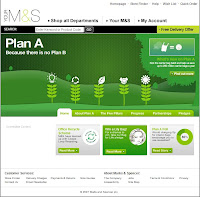
If you've spent time in London, you can't help but be familiar with Marks & Spencer . Their brilliant decision to put ready-made food stores in major transporation hubs has forever cemented the brand in my mind as an insightful innovator. But, having purchased their ready-made meals, I can tell you it made me feel like I was contributing more than a reasonable share of waste to the world with just one dinner. Now that I know about Plan A, my concerns are a bit allayed. And, I have a helluva lot of respect for them, too. In this article from the Times, their CEO, Sir Stuart Rose, shares a year-one update on their ambitious five-year, 100-point, eco plan.

In my book, Plan A gets points for both substance and branding. I like it for what it is and how its structured: it's ability to create the "virtuous circle" between suppliers, the brand, employees and consumers over a specified period of time. It's both lofty and tangible. It makes everyone accountable, and transforms good principles into action. And, the marketer in me likes the way they've "packaged" their ideas. They hang around the tagline "Plan A. Because there is no Plan B." Brief, to the point, and meaningful. They created a site that showcases more information and successes around their five pillars: Climate change, Waste, Sustainable raw materials, Fair partner and Health. I can't help but applaud them for getting beyond "green" to promote fair labor practices and healthier lifestyles for their customers and employees. And they launched it all a year ago. Having worked with a major supermarket chain in the US who kept a close eye on the innovations of M&S and Tesco, I'm sure Walmart drew inspiration from Plan A for their own sustainability efforts. (More on that later.)

Finally, Rose shares with us that he continues "to believe strongly that Plan A is not only the right thing to do, but commercially will help differentiate us in the eyes of our customers. Simply put, it’s a win-win." Take that, Milton.